
Stretching hasn't fixed it. Rest didn't fix it. That doesn't mean nothing will.
When pain persists despite doing everything you're supposed to — rest, stretching, foam rolling, ice — the problem often isn't in the muscle itself. It's in the fascia: the connective tissue that wraps every muscle and nerve in your body. At Acumotion Sports Therapy & Acupuncture in Windsor, we use Manual Myofascial Therapy and Asian Orthopedic Therapies to find and treat the fascial restrictions and trigger points that keep pain coming back.
Myofascial pain is the most overlooked source of chronic musculoskeletal pain.
Myofascial pain syndrome involves trigger points — hyperirritable knots within taut bands of muscle that produce predictable referred pain patterns. Press a spot in your shoulder and feel it behind your eye? That is a trigger point referral. Fascia, the connective tissue wrapping every muscle, bone, and nerve, becomes restricted or adhered after injury, overuse, or prolonged postural stress. Because fascia is one continuous structure, a restriction in your hip can pull on your low back. A restriction in your neck can contribute to headaches. Research confirms that symptomatic fascia shows measurable changes including fibrosis, thickening, and inflammatory activity — and that fascia is richly innervated with pain-sensing nerve endings.
Fascial dysfunction rarely starts where you feel the pain.
Common causes include repetitive strain from work or sport. In Northern Colorado, that means golf rotation, trail running impact, and sustained desk postures for remote workers. Acute injuries that healed incompletely leave behind fascial restrictions that alter movement mechanics long after the original injury resolved. Surgical scarring binds fascial layers that should move independently. Protective muscle guarding — when your nervous system tightens surrounding muscles in response to pain — can itself become a chronic pain source.
The pain pattern tells a story — and it's rarely random.
Patients describe deep, aching pain that feels like it is in the muscle, not the joint. Referred pain is the hallmark — a trigger point in the gluteals can send pain down the leg in a pattern nearly identical to sciatica. Pain often moves or spreads over time. Stiffness is worst in the morning. Tissues feel like they catch or pull during certain movements. Areas that should not hurt feel tender when pressed. Myofascial pain can coexist with arthritis, disc pathology, or nerve impingement — and may be the component previous treatments missed.
Most myofascial pain is not dangerous — but some symptoms require immediate evaluation.
Seek medical evaluation before pursuing manual therapy if you have unexplained weight loss with persistent pain, night pain that consistently wakes you from sleep, fever or chills alongside musculoskeletal pain, progressive weakness in an arm or leg, loss of bowel or bladder control, pain after significant trauma, or new pain with a history of cancer. These are uncommon, but they matter — a thorough evaluation distinguishes myofascial pain from conditions requiring different management.
Diagnosis requires hands-on assessment — not just imaging.
There's no single scan that diagnoses myofascial pain. Evaluation relies on a detailed history and skilled palpation. At your first visit, we map your pain history, assess movement patterns for compensations and asymmetries, palpate soft tissues for taut bands and fascial restrictions, identify trigger points that reproduce your familiar pain, and screen for joint, nerve, and systemic causes. Many patients have been told their MRI looks fine but still hurt — the pain generator may be in fascia and muscle, which standard imaging doesn't capture.
Two evidence-informed pathways: Manual Myofascial Therapy and Asian Orthopedic Therapies.
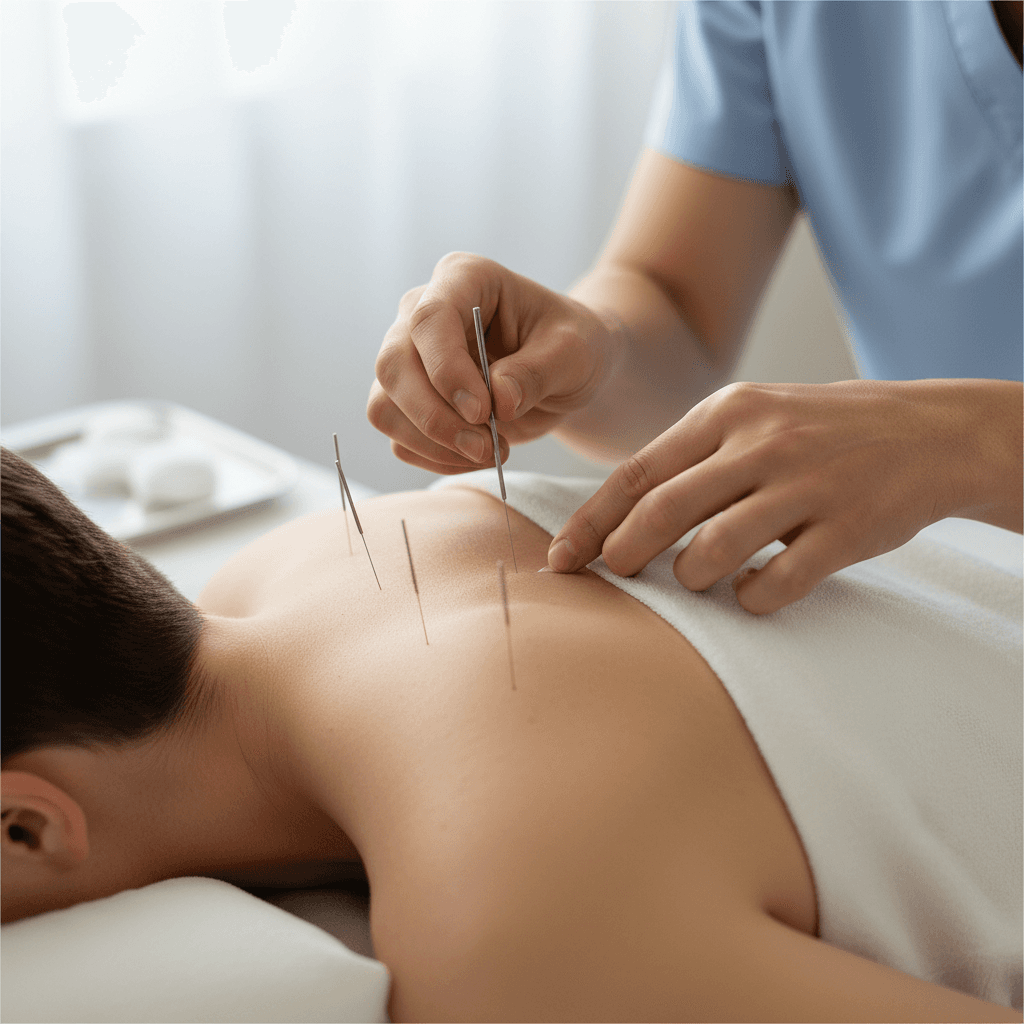
Manual Myofascial Therapy targets fascial restrictions through myofascial release (sustained pressure to restore tissue glide), dry needling (thin needles into trigger points and motor points), cupping (negative pressure to separate fascial layers), and instrument-assisted soft tissue work. A 2021 meta-analysis found myofascial release produced significant improvements for chronic low back pain. Asian Orthopedic Therapies uses acupuncture, motor point needling, and electroacupuncture to reduce pain and restore normal muscle activation patterns. These are complementary tools, not competing approaches — they are combined in a single session. Each session is one full hour of one-on-one doctoral-level care with Dr. Geno Diveley, DACM, L.Ac.
Six modalities. One session. Built around your condition.
We combine acupuncture, dry needling, and manual therapy to address myofascial pain at its source. Each treatment plan is built around your specific condition and recovery goals.
Dry Needling
Targets trigger points and motor points to deactivate painful knots

Myofascial Release
Sustained pressure to release fascial restrictions

Cupping Therapy
Separates fascial layers and improves circulation

Motor Point Therapy
Resets dysfunctional activation patterns

Electroacupuncture
Pain management and neuromuscular rehab

Trigger Point Therapy
Treats trigger points and referred pain patterns
Your myofascial pain questions, answered
Answers to the questions we hear most in the clinic.
Your fascia has been compensating long enough.
If your pain has persisted through rest, stretching, and previous treatments, the fascial system may be the missing piece. Schedule an evaluation at our Windsor clinic at 624 Main St. #3 and get a clear explanation of what's generating your pain — and what can be done about it.